A Level
A level exam board: CCEA
| Module | % of AS or A2 grade | How is it assessed? | Module Title |
|---|---|---|---|
| AS Module 1 | 40% AS 16% A2 | 1hr 30mins | Basic Concepts in Physical and Inorganic Chemistry |
| AS Module 2 | 40% AS 16% A2 | 1hr 30mins | Further Physical and Inorganic Chemistry and Introduction to Organic Chemistry |
| AS Module 3 | 20% AS 8% A2 | Booklet A 1hr 15mins Booklet B 1hr 15mins |
Basic Practical Chemistry |
| A2 Module 1 | 40% A2 24% A level | 2hrs | Further Physical and Organic Chemistry |
| A2 Module 2 | 40% A2 24% A level | 2hrs | Analytical, Transition metals, Electrochemistry and Organic Nitrogen Chemistry |
| A2 Module 3 | 20% A2 12% A level | Booklet A 1hr 15mins Booklet B 1hr 15mins |
Further Practical Chemistry |
GCSE
GCSE exam board: CCEA
| GCSE | % of GCSE grade | How is it assessed? | Unit title |
|---|---|---|---|
| Unit 1 | 35% | 1hr 15mins at end of Y11 | Structures, Trends, Chemical Reactions, Quantitative Chemistry and Analysis |
| Unit 2 | 40% | 1hr 30mins at end of Y12 | Further Chemical Reactions, Equilibrium, Calculations and Materials |
| Unit 3 | 7.5% 17.5% |
2hr practical exam between Jan and May of Y12 1hr written paper at end of Yr12 |
Organic Chemistry and Practical Skills |
Alternatively, students may opt to study Chemistry as part of the Double Award Science or Single Award Science.
KS3: Brief topic overview
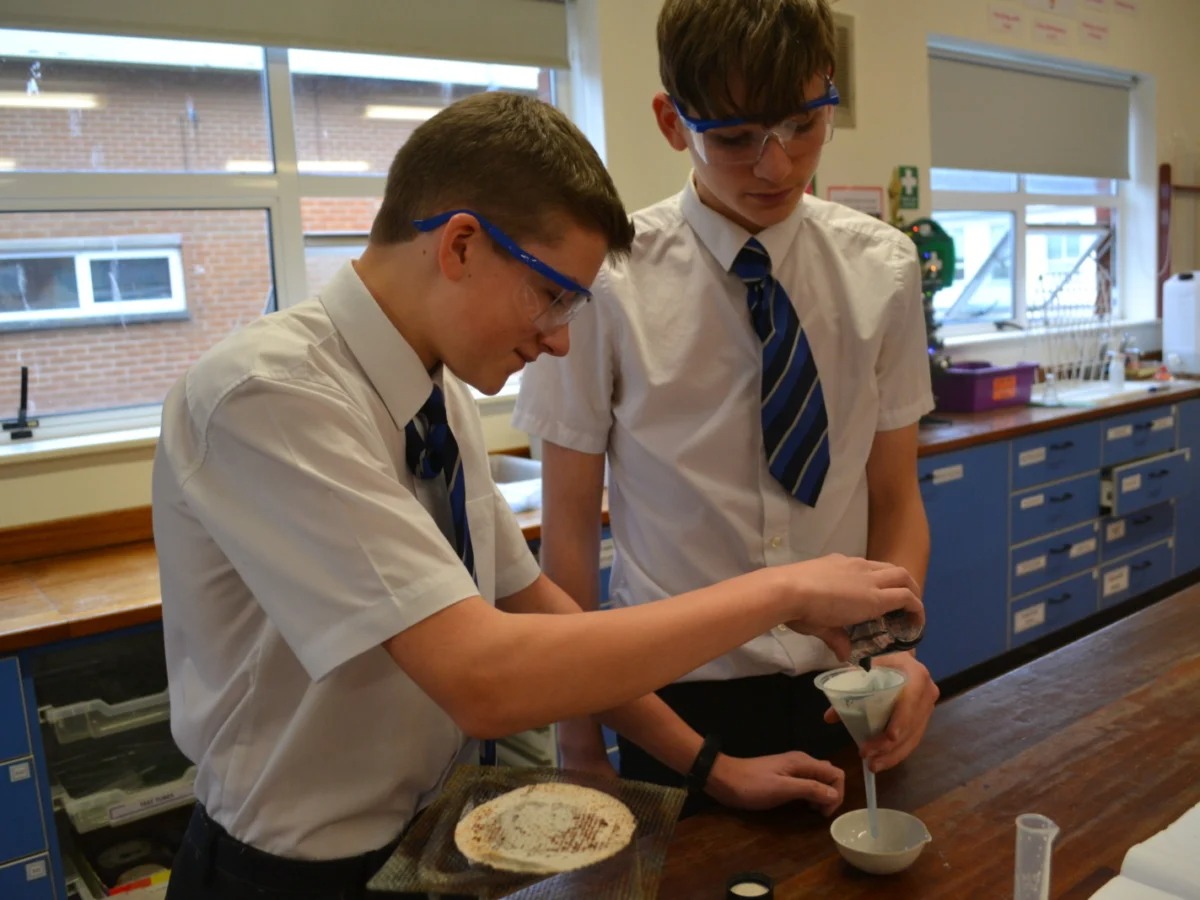
Y8 Taught as Combined Science. Chemistry topics involved are – What are we made of?, Chemical & Physical Changes, Elements, Mixtures & Compounds, Separating techniques.
Y9 Taught as Combined Science. Chemistry topics involved are Farming & Chemistry, Fizzes & Bangs, Chemistry & Cars.
Y10 Periodic Table and Atomic Structure, Salt Preparation and Analytical Chemistry, Chemical Engineering, Ionic Bonding, Formulae and Mole.